
Financial Diet: Using No Spend/Low Spend To Jumpstart Your Finances
Scroll through TikTok or Instagram right now, and you'll see thousands of people documenting their no-spend or low-spend journeys. What started as a niche personal finance experiment has become a full-blown movement, with people freezing their TJ Max runs, deleting food delivery apps, and finally asking themselves the question that changes everything: Where is my money actually going?
Whether you're trying to recover from holiday spending, save for a major goal, or simply want to understand your relationship with money, a spending challenge might be exactly what you need. But before you dive in, let's make sure you're doing it right—because the difference between a challenge that changes your life and one that just frustrates you comes down to preparation.
Your “new money” season could start in January or June (most people also jumpstart their money in July/September), starting fresh when it comes to your funds is never too late. No closed season has many meanings beyond the church.
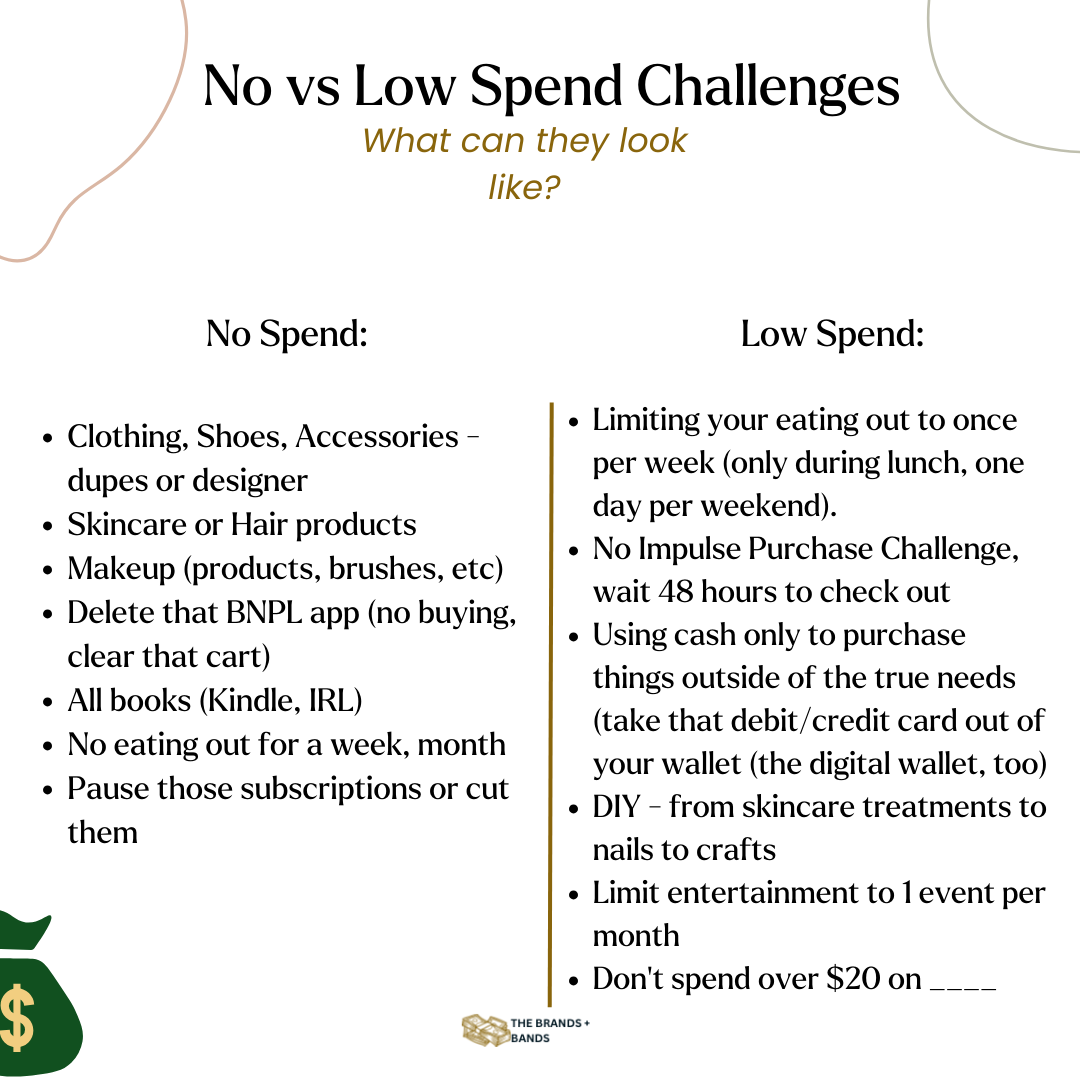
One of the most popular exercises people tend to do when getting their money stacking right is “No or Low Spend “Challenges. With these, think of the game you used to play back in the day - freeze tag. During these types of challenges, you’re technically doing a spending freeze. YES - no spending a thing. Think of them like being on a financial fast or diet.
When you hear “no/low spend, you probably instantly go into a panic about no spending money, but it’s so much more than that:
Save money and pay off debt: The most obvious benefit is saving money! I mean, that’s what you’re probably doing this challenge to do. The saved money from doing this can be used to pay off debt, build an emergency fund, or reach your other financial goals faster.
Boost your awareness of your money: A lot of people have a budget but don’t know how much their life costs. You'll start to track your expenses, identify areas where you can cut back, and gain a better understanding of your financial needs. This is true compound interest.
Break the cycle of impulse buying: A low/no spend challenge can help you break this cycle by forcing you to be more intentional about your purchases. You'll learn to appreciate what you already have and resist the urge to buy things on a whim. Also, unlock your currency cycle (how long money stays in your procession and what impacts it by certain days, etc).
Reduce stress and improve financial wellness (in your wallet): Financial stress can take a toll on your mental and physical health. By taking control of your finances, you can reduce stress and anxiety. You may also find that you have more time and energy for the things that truly matter to you.
Increase gratitude: When you stop buying things on autopilot, you start to appreciate what you already have. This can lead to a greater sense of gratitude and contentment.
Pinpoint why the math isn’t math-ing: When you're limited in your spending, you get creative! You'll find new ways to have fun, entertain yourself, and get what you need without spending money.
Feel a sense of accomplishment: Sticking to a low/no spend challenge can be challenging, but it's also very rewarding. Every day that you stick to your goals is a victory! You'll gain a sense of accomplishment and confidence in your ability to manage your finances.
Before You Start: Audit Your Wallet
Before jumping into any challenge, you need to know what you're working with. Think of this as your financial baseline—without it, you're just guessing. Doing an audit of your wallet helps jumpstart your budget, saving money, investing, or challenges like these. For you to know how to go with your dough, you need to know where you’re currently with your flow.
Pull out your last two to three months of bank and credit card statements. Now, compare them to your budget (if you have one) or simply categorize your spending if you don't. What you're looking for:
If you see scattered overspending across multiple categories (eating out is over budget, shopping is over budget, subscriptions you forgot about, random Amazon purchases), you likely need an overall money shift. A traditional no-spend challenge that covers all discretionary spending might be your path.
If you see one or two problem categories (hello, $400 in DoorDash last month), you need targeted intervention. A category-specific challenge or low-spend/buy—like no eating out or no online shopping or BNPL—will serve you better than trying to restrict everything at once.
This audit isn't about shame. It's about clarity. You can't fix what you don't acknowledge, and you can't create a meaningful challenge without knowing what you're actually challenging.
The Three Phases Every Successful Challenge Needs
Most people jump straight into restriction mode without a plan. That's why so many challenges fail by day three. If you want this to actually work, you need to move through three critical phases:
Phase 1: Data
This is where you did your wallet audit, but now you go deeper. Look at your numbers and get specific about your objective. Ask yourself:
Do I want to curb my eating out habits specifically?
Am I trying to understand my spending outside of bills?
Do I have a shopping problem I need to address?
Am I trying to save for something specific?
Do I just need a financial reset after a difficult season?
Your "why" matters. A challenge without a clear objective is just deprivation for deprivation's sake—and that doesn't create lasting change. Write down your specific goal. Make it real.
Phase 2: Duration
Now that you know why you're doing this, decide how you'll do it:
What type of challenge? Full no-spend? Low-spend with a budget cap? Category-specific freeze?
What are your rules? What counts as essential? What are your exemptions? (Be honest but not too lenient.)
How long will you commit? A weekend sprint? A week? A full month? (Refer to the sprint/stride/marathon breakdown below for guidance.)
Set check-in periods. Don't wait until the end to evaluate how things are going. Schedule a mid-challenge check-in (halfway through, or weekly if it's a month-long challenge) to assess:
Is this working?
Do my rules need adjusting?
What am I learning about my spending?
Am I meeting my objective, or do I need to pivot?
Flexibility isn't failure—it's wisdom. If something isn't working, adjust before you burn out and quit altogether.
Phase 3: Debrief
The challenge is over. Now what? This is the phase most people skip, and it's the most important one.
Sit down with your data again. Ask yourself:
What changed during this challenge?
What patterns did I notice?
What was harder than expected? What was easier?
Did I meet my objective?
What will I continue doing differently?
Here's the hard truth: If you do a challenge and nothing changes in your life afterward, did you really do it with the right intention? A spending challenge isn't a punishment or a one-time event—it's a diagnostic tool and a behavior reset. The goal isn't to white-knuckle your way through deprivation; it's to gain awareness, break patterns, and build better habits.
If you emerge from your challenge and immediately return to your old spending patterns, you missed the point. Use what you learned. Let it inform your budget, your goals, and your daily choices moving forward.
Getting Started with Your No/Low Spend Challenge:
1. Pick Your Focus:
No-Spend: Go full throttle and eliminate all non-essentials for a set period. Think of it as a financial sprint!
Low-Spend: Set a realistic weekly or monthly budget cap for non-essentials. Think of it as a financial marathon.
Also determine how long are you going to do it: A month or a week.
2. Define "Essentials" + Exemptions:
Make it clear what expenses still count during your challenge. Groceries, rent, bills? Transportation?
Be honest with yourself, but leave some room for flexibility (e.g., occasional birthday gifts).
Look at your budget to determine what’s going on within your money.
3. Stock Up and Plan:
Fill your pantry with staples to avoid unnecessary grocery trips.
Plan fun, free activities for entertainment. Libraries, parks, potlucks - get creative!
Inform family and friends about your challenge for understanding and support.
4. Track and Celebrate:
Use a spending tracker app or a simple spreadsheet to visualize your progress.
Reward yourself for milestones (e.g., a free movie night after a week of no takeout).
Share your journey with friends or online communities for motivation and accountability.
5. Adapt and Adjust:
Don't be afraid to tweak your rules if something isn't working. Flexibility is key.
Unexpected expenses pop up? Evaluate if they're truly essential or find creative solutions.
Remember, challenges are personal. Make it your own and have fun in the process!
Tip: Want to build your savings during these challenges? If you skip on something, however much you would’ve spent gets shipped or flipped to your savings. Like if you notice during your no-spend on shopping that your favorite designer launched a new line or had a drop of a specific item - move some cash to your stash while you pass this challenge. This will help build your savings, and if it’s still available - you don’t have to crash your budget due to having the cash in your savings account.
Questions to ask yourself throughout the experience:
Is this a need-to-have or a nice-to-have?
How often will I use this or could I wait until after to do this?
Is it a trend or will it add to my life long-term?
Is it of good quality?
Do I own something like this already?
Can I thrift this (if it’s clothes)?
Using questions like this will help you even when the challenge is finished.
The Experience (The Actual Challenge):
Typically — you hear about people doing these sorts of challenges by the month, but I wanted to show you it can be personalized to you. I honestly would suggest you do them for no longer than a month if you’re just starting with them. Like a ‘fast’ it will have you feeling like you can’t do it at first, but if you plan before it becomes practice, it will be more practical during all of it. When it comes to setting up how long your “no/low spend” challenge will be, let’s see what they look like in phases:
Sprints (weekend to 1 week):
These are great for beginners: Allows you to test the waters and build momentum without feeling overwhelmed.
Provides quick results: You'll see a noticeable impact on your spending soon, which can be motivating.
Easier to stick to - Less time means fewer opportunities for slip-ups and frustration.
Strides (1-4 weeks):
Offers a good balance: Gives you enough time to make significant progress while still being manageable.
Ideal for specific goals: If you're saving for a short-term goal like a purse or SLG, this timeframe can be perfect.
Requires more planning and commitment: Stock up on essentials and have alternative activities prepared for longer periods.
Marathon (1 month and beyond):
The ultimate test of willpower: Can be an intense but rewarding experience that significantly boosts your financial awareness.
Perfect for major goals: Ideal for saving for a large purchase or paying off debt.
May require significant lifestyle adjustments: You'll need to be creative and disciplined to maintain the challenge for longer periods.
You could start with one area, access how you did, and then determine which works for you. Would also recommend that you start with focusing on one thing - it could be not going to Target for a set amount of time or getting off of Jeff Bezos’ internet for a month. People are starting to remove the apps of convenience to help them save.
Let’s break them down by what level you are to see what other ways you can start a “No/Low Challenge”, pick one and start:
Beginners:
One-Week [ Anything] Freeze: Challenge yourself to avoid eating out or drinking Starbies for a week. Opt for home-cooked meals, picnics in the park, or meal prepping.
Entertainment Flip: Trade expensive movie nights for board game nights with friends, or explore free online resources like educational videos or open-access books.
No Impulse Purchases Week: Resist the urge to buy anything on a whim for a week. Make a list of things you need, and wait at least 24 hours before purchasing anything else.
Intermediate:
Monthly "No-Shop" Experiment: Pick a non-essential category like clothes, shoes, or electronics and avoid buying anything in that category for a month. Get creative with what you already have!
DIY Challenge: Instead of buying new crafts, decorations, or home improvement items, try making them yourself. You'll save money and unleash your inner creative spirit.
Transportation Tweak: Challenge yourself to walk, bike, or use public transportation instead of driving for a week or month. It's good for your health and your wallet!
Advanced:
One-Month Entertainment Blackout: Take a complete break from paid entertainment services like streaming subscriptions, cable TV, and concert tickets. Explore free alternatives like local library events, park activities, or volunteer work.
Cash Only Week: Limit yourself to a fixed amount of cash for the week and stick to it for all purchases. This forces you to prioritize and become more conscious of your spending. I spoke about this with Bustle on how to do this effectively.
Digital Detox Challenge: Disconnect from social media and online shopping websites for a set period. You'll be surprised how much time and money you save! You can also set limits via your phone to keep you even more focused, and accountable. You don’t have to announce when you do this either! Ha!
Say that you are rewarding yourself for hitting milestones throughout your experience (1 week, 1 month, etc). Here are some examples:
Home Spa Day:
After completing the first week or two, treat yourself to a relaxing home spa day. Use affordable skincare products, take a long bath, and pamper yourself without spending much. Or find a coupon to get either a new product or service, and set a limit.
Cooking Class or Book:
If you've been focusing on cooking at home, reward yourself with a cooking class (many are available online for free) or a new recipe book to expand your culinary skills.
New Plant Baby:

Celebrate a milestone by adding a touch of nature to your home. Buy a new houseplant or a bouquet of fresh flowers to brighten up your living space.
Workout Aufit (Outfit):
You look good, you feel good for everything, especially the gym. If part of your challenge involves prioritizing health and fitness, consider rewarding yourself with a new piece of affordable fitness gear, such as resistance bands, a yoga mat, or a jump rope.
Where Does The Money Go?
One of the things that people don’t say about “No/Low Spend” Challenges is where you put the money. I talked about this over on my YT, how anything extra that I save either gets put directly into a bill or debt or saved into my HYSA. So when you finish this challenge, add up your savings (celebrate yourself) and then move that money to grow.
Share with me over on social media what you’re going to do as far as your “No/Low Spend” Challenge or you can comment below about it. This also allows you to find your money formula to make it even better no matter if it’s the beginning or the year or a day that ends in “Y” on some random month.