

When Your Employees Can't Stop Thinking About Money, Your Business Feels It Too
Let's talk about what's actually happening in workrooms, Zoom calls, and break rooms across this country right now. A random Teams meeting invite already shakes employees due to the layoffs not laying off. Unlike Mark Z, the morale at companies isn’t giving “we are a family” or culture, but concerned. Not just about their paycheck, but their position in general.
People are showing up to work — but they're not really there. They're calculating whether they can cover rent after payroll hits. They're wondering if they should pull from their 401(k) to cover an emergency. They're nodding along in meetings while running through debt math in their heads.
This isn't a character flaw. It's a financial system problem — and it's costing companies more than they realize.
A 2026 PwC Employee Financial Wellness Survey just put hard numbers to what I've been seeing on the ground:
59% of employees said they're stressed about their finances
49% said their compensation isn't keeping up with costs
53% have less than $5,000 saved for emergencies — and 30% have less than $1,000
52% don't feel capable of planning for long-term financial goals
41% said their education or background never prepared them to manage money at all
And from a 2025 Hartford report: nearly 3 in 4 U.S. workers said financial stress is affecting them at work — with 56% saying it's directly hurting their productivity.
That's not a wellness problem. That's a business problem. And a benefits PDF isn't going to fix it.
Unlike what Mark Z would have you believe, the vibe at most companies isn't "we are a family." It's concerned. Not just about the paycheck, but about the position altogether. People are walking into work — or logging on — with one eye on the Slack channels and one eye on their bank account.
And here's what nobody in the C-suite wants to say out loud: that's not a morale problem. That's a money problem.
Let's unpack it a bit.
People are showing up to work — but they're not really there. They're calculating whether they can cover rent after payroll hits. They're wondering if they should pull from their 401(k) to cover an emergency. They're nodding along in meetings while running through debt math in their heads.
This isn't a character flaw. It's a financial stress problem — and it's costing companies more than they realize. Nothing to ‘put a pin in’, but that’s what’s happening.
A 2026 PwC Employee Financial Wellness Survey just put hard numbers to what I've been seeing on the ground:
59% of employees said they're stressed about their finances
49% said their compensation isn't keeping up with costs
53% have less than $5,000 saved for emergencies — and 30% have less than $1,000
52% don't feel capable of planning for long-term financial goals
41% said their education or background never prepared them to manage money at all
And from a 2025 Hartford report: nearly 3 in 4 U.S. workers said financial stress is affecting them at work — with 56% saying it's directly hurting their productivity.
That's not a wellness problem. That's a business problem. And a benefits PDF isn't going to fix it.
What I Saw When I Walked Into the Room With Patelco Credit Union Members
Earlier this year, I had the privilege of leading a financial wellness webinar for members of Patelco Credit Union. These were real people — who showed up to a digital room because they wanted help. Not because someone forced them. Because they needed it. And they came ready.
What I found in that room confirmed everything the data says — and then some.
People weren't struggling because they were careless with money. They were struggling because money was never made plain for them. No one broke it down in a way that was relatable, judgment-free, and actually applicable to their real life. They were managing their finances in their heads, reacting instead of planning, and carrying a weight of shame that kept them from asking for help sooner.
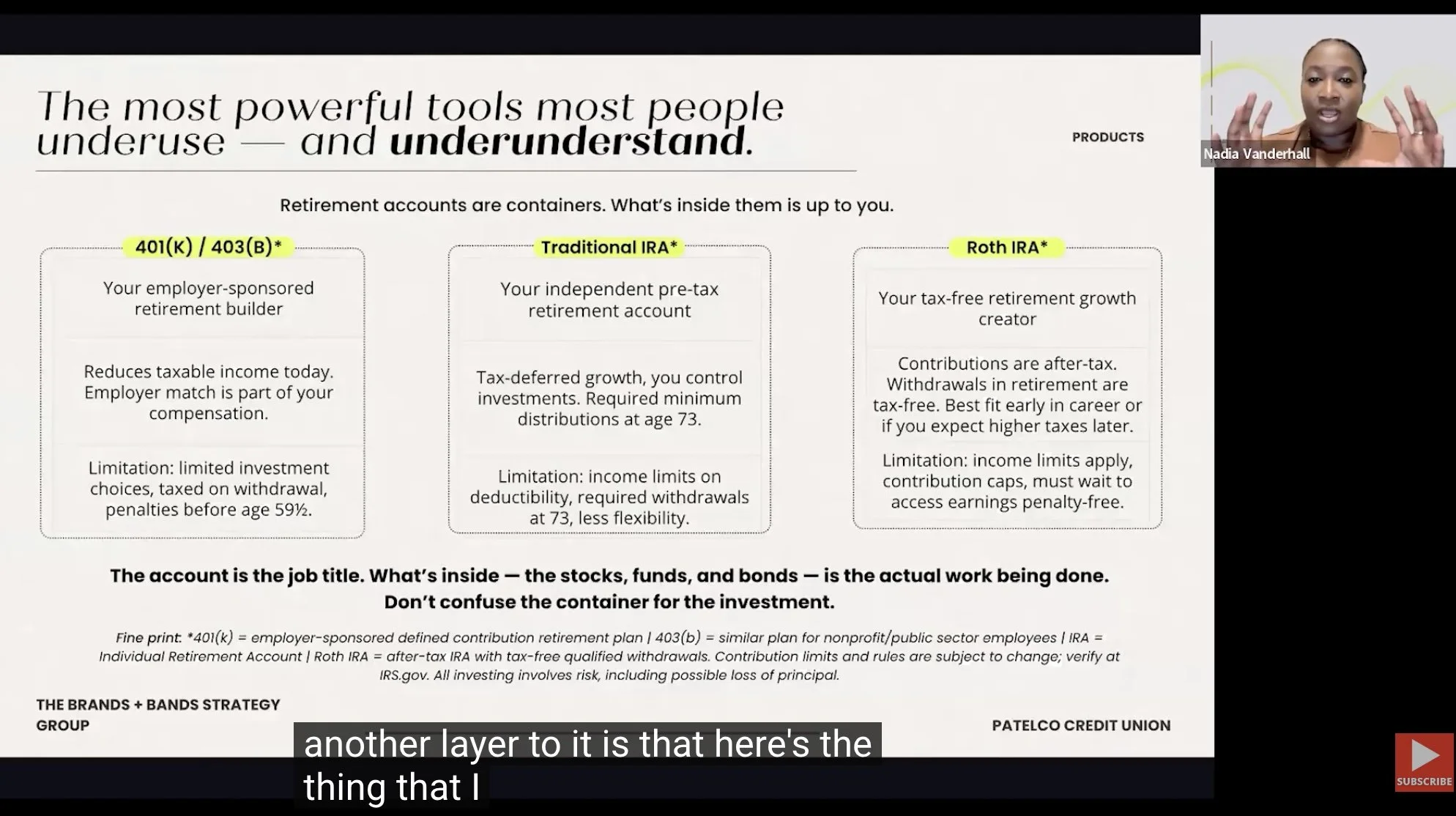
Screengrab of Financial Wellness presentation.
Here's what we covered — and why it actually landed:
The energy of money. We talked about how the way you think about money directly affects how you use it. One member said it best: "Hearing about how money's energy and the way we think about money affects how we use our money was very helpful." That mindset shift alone changes everything. You can't budget your way out of a scarcity mindset.
Savings — it's about the habit, not the amount. We tackled the guilt around not having "enough" saved. Members walked away understanding that consistency beats the dollar amount every time. One attendee put it plainly: "It was also helpful to hear that the amount of money we set aside is not as important as the practice of regular savings habits." That's the unlock.
The Opportunity Fund. I don't call it an emergency fund — I call it an opportunity fund. One member specifically called this out: "I love the phrase 'opportunity fund.' It sounds hopeful." Language matters more than people think. When you stop bracing for disaster and start building for possibility, the whole relationship with saving changes.
A savings pyramid — visual, practical, no fluff. We used a framework to break down different types of savings goals by priority. Members said the pyramid imagery made it click in a way that abstract advice never had. Concepts need visuals. Visuals need context. Context creates action.
Financial products, explained in plain English. Members left with a clearer understanding of the tools already available to them — without the jargon that usually makes people tune out. One attendee noted: "Her knowledge of financial products was very expansive and helpful."
The feedback didn't stop there. People said the session was "informative and relatable," that I was "witty and engaging," and — my personal favorite — "I could apply it now." That's the goal every single time.
When you give people frameworks instead of lectures, they stop feeling like the problem. They start feeling like they finally have the tools.
That's what financial wellness education is supposed to do.
What Companies Are Missing
Honestly, truly — most companies that offer financial wellness benefits bury them.
They're sitting in a PDF in the HR portal. They get a one-line mention during open enrollment. Nobody's talking about them, nobody's promoting them, and employees who are already embarrassed about their finances are definitely not going digging for resources on their own.
PwC's research backs this up — employees said they're often too embarrassed to even ask for financial guidance. But here's what's wild: 83% of Gen Z and 79% of millennial employees who did have access to employer financial wellness services actually used them — to pay down debt, control their spending, and increase their savings.
The demand is there. The need is there. What's missing is the bridge — judgment-free, real-talk financial education that meets people where they actually are.
Not where HR hopes they are. Where they actually are.
And that's exactly what I do.
What Financial Wellness Actually Looks Like In Practice
It's not a one-pager about your EAP. It's not a generic budgeting app login nobody opens.
Real financial wellness education is:
Accessible. People have to be able to show up without feeling like they need a finance degree just to follow along.
Shame-free. PwC found that employees defined financial wellness as "less stress, fewer surprises, and the freedom to make financial choices with confidence." That's the bar. Not a webinar checkbox — actual confidence. People don't want to be talked at. They want to feel capable. No finance bro antics with me; I’ve talked about my own money hiccups.
Connected to real life. When people understand how a benefit solves a financial problem they're already losing sleep over, they use it. Financial education has to connect the dots — between the paycheck, the debt, the goals, and the tools already on the table. My perspective on the economy is different than most talking heads.
Taught by someone who actually gets it. Not a slide deck. Not a compliance module. A real conversation with a real financial educator who has been in the mess, built the way out, and can talk about it without making people feel small.
That's what we brought to Patelco's members. That's what I bring to every room I'm in.
The ROI Nobody Talks About
Financially stressed employees are less engaged, less productive, and more likely to walk. When companies invest in real financial education, they're not just doing a nice thing — they're protecting the business.
The data says 48% of employees are highly motivated to learn about budgeting, investing, building credit, and managing debt. They want to learn. They just haven't been given the right room to do it in yet.
You can create that room. I can help you fill it.
Ready To Bring This To Your Team, Organization, or Conference?
If you're an HR leader, a credit union, a financial institution, or an organization that wants to do more than just check the wellness box — let's talk. Reach out via email at hello@thebrandsandbands.com.
And while this post is focused on the employee experience, this is the same perspective I bring to panels, conferences, and industry events. The conversation around financial stress, economic uncertainty, and what it means for everyday people? That's my lane — whether I'm on a stage with industry leaders, moderating a panel, or in a virtual room with a community who just needs someone to break it down plainly and without judgment.
I lead workshops, webinars, keynotes, and panel discussions that help people actually understand their money — not just hear about it. The Patelco session is proof that when you give people a judgment-free space and a real framework, they show up, they engage, and they leave different than they arrived.
Book me to speak at your next event or bring financial wellness to your team.
Your employees and community are already thinking about money. Let's make sure those thoughts are moving them forward — not holding them back. Want to see what it’s like to prepare for my virtual talks (which can be done in person too)? Check out this short video.
Dassit.
Here’s some testimonials from the webinar series:
“I appreciated the discussion including a broader range of situations, especially since 1 am nearing retirement age, but am nowhere near in a position to actually do so.” - Attendee
“The presenter shared a wealth of knowledge and reassured the participants that it's never too late to begin saving for retirement which I found very encouraging and rare!”- Attendee
“The presentation covered all the information about investing and making a person's money work for them. There were also great examples shared by the presenter.” - Attendee
“The presentation offered me some different perspectives on setting aside money and savings.” - Attendee
“Hearing about how money's energy and the way we think about money affects how we use our money was very helpful. It was also helpful to hear that the amount of money we set aside is not as important as the practice of regular savings habits.” - Attendee
“Great presentation. I know have information on to move forward as a retiree. Thank you.” - Attendee
“She was really witty and engaging” - Attendee
“Most 1 knew already, a good refresher!”- Attendee
“I love the phrase 'opportunity fund'. It sounds hopeful. I appreciated the pyramid imagery for types of savings goals.” - Attendee
“The presenter as well as the presentation was informative and relatable” - Attendee
Sources: PwC 2026 Employee Financial Wellness Survey via HR Dive | The Hartford 2025 Employee Financial Wellness Report
